
Colour Theory for Print: Translating Digital Vibrancy to Offset Precision
Colour Theory for Print: Translating Digital Vibrancy to Offset Precision
Main article content
For designers and brand managers, few things are more frustrating than seeing a vibrant digital design look dull or inconsistent when it rolls off the press. The disconnect isn’t the printer’s fault; it’s a fundamental difference between how screens render light and how paper absorbs ink. Understanding how to translate digital vibrancy to offset precision is essential for maintaining brand integrity and achieving spectacular print results.
The core issue lies in the two colour models: RGB (Red, Green, Blue) and CMYK (Cyan, Magenta, Yellow, Black). RGB is an additive colour model used by screens; it creates white by adding light. CMYK is a subtractive model used in printing; it creates colour by subtracting light (absorbing certain wavelengths) and adds black to deepen shadows. Because the CMYK gamut (the range of colours it can reproduce) is significantly smaller than RGB, many bright digital colours simply cannot be replicated using the four process inks.
The Role of Spot Colours (Pantone)
To achieve guaranteed colour fidelity for critical brand elements like logos, the solution is often a Spot Colour, most commonly referenced using the Pantone Matching System (PMS). A Spot Colour is a pre-mixed, custom ink (a fifth colour) applied to the page.
Using a Pantone colour ensures that whether your brochure is printed this month or next year, the specific shade of your corporate blue or signature red will be exact. While using spot colours adds a plate cost, the precision, consistency, and inability to replicate it digitally often makes it the most cost-effective choice for reinforcing premium brand identity.
Understanding CMYK Precision
For photographic or full-colour reproduction, you must master the four-colour process. A key technique here is GCR (Gray Component Replacement). GCR replaces a percentage of the Cyan, Magenta, and Yellow inks with Black (K) ink in neutral or shaded areas. This has several benefits:
- Richer Blacks and Neutrals: It produces deeper, more stable neutral tones that are less susceptible to colour shifts.
- Cost and Efficiency: Replacing expensive CMY inks with less expensive Black ink reduces ink consumption and improves drying time.
Without proper colour management and GCR, rich blacks can appear muddy, and deep shadows might lose critical detail.
Avoiding Pitfalls: Designing for Paper
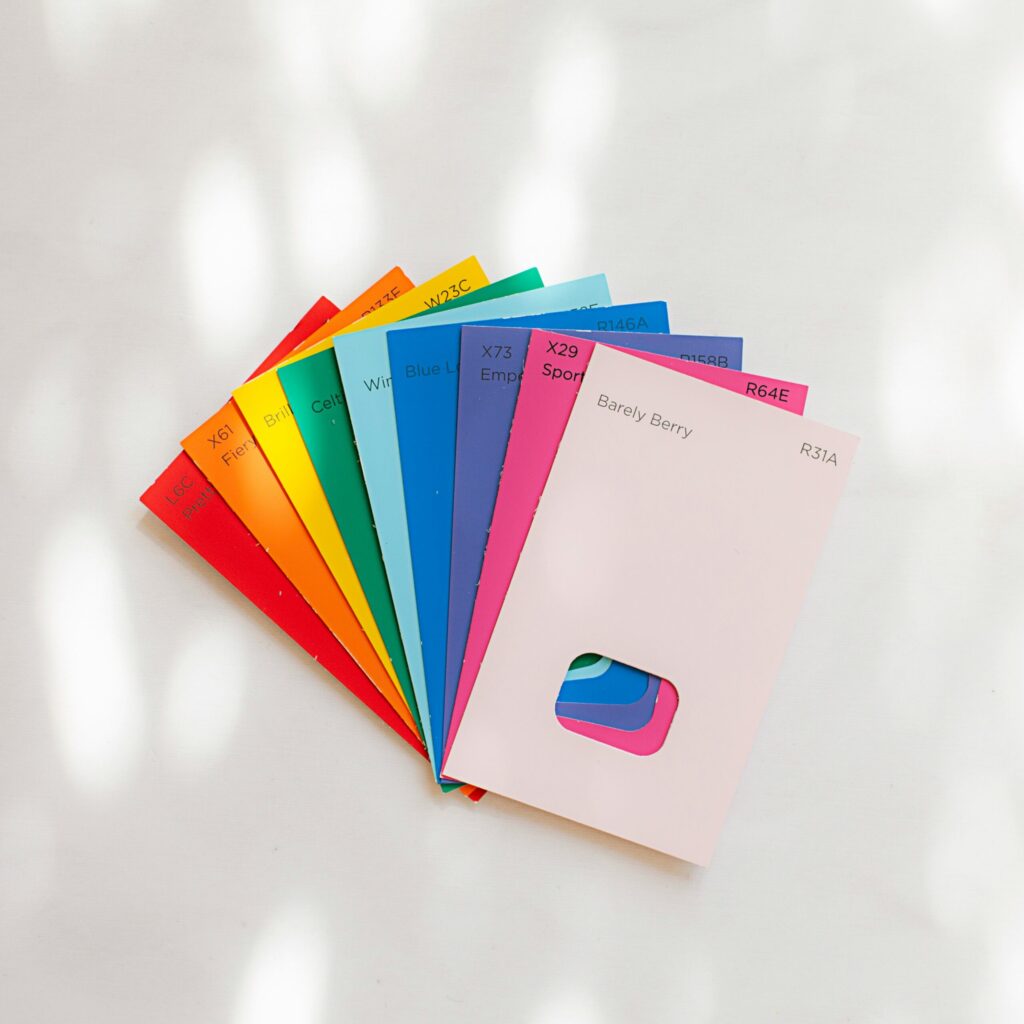
Designers should always begin with a CMYK document mode and regularly consult a physical Pantone colour bridge to see how their colours will translate. Never rely solely on the screen. The paper stock also plays a critical role:
- Coated Paper (with a smooth finish) allows inks to sit on the surface, resulting in sharper detail and richer colour saturation.
- Uncoated Paper absorbs ink, leading to a softer, more muted, and slightly less vibrant result.
By respecting the constraints of CMYK, strategically using Spot Colours for brand elements, and understanding how GCR and paper choice influence the final outcome, you ensure your design retains its integrity. Colour is a powerful tool for consistency and recall; mastering its translation from pixel to paper is the hallmark of professional, high-impact print work.